
Fungal infections are often treated as a niche clinical problem. They are not. Severe fungal diseases cause a major global burden of illness and death, particularly among people with impaired immunity, critical illness, cancer, transplantation, HIV infection or severe respiratory disease. Yet fungal infections remain underdiagnosed, underfunded and difficult to treat.
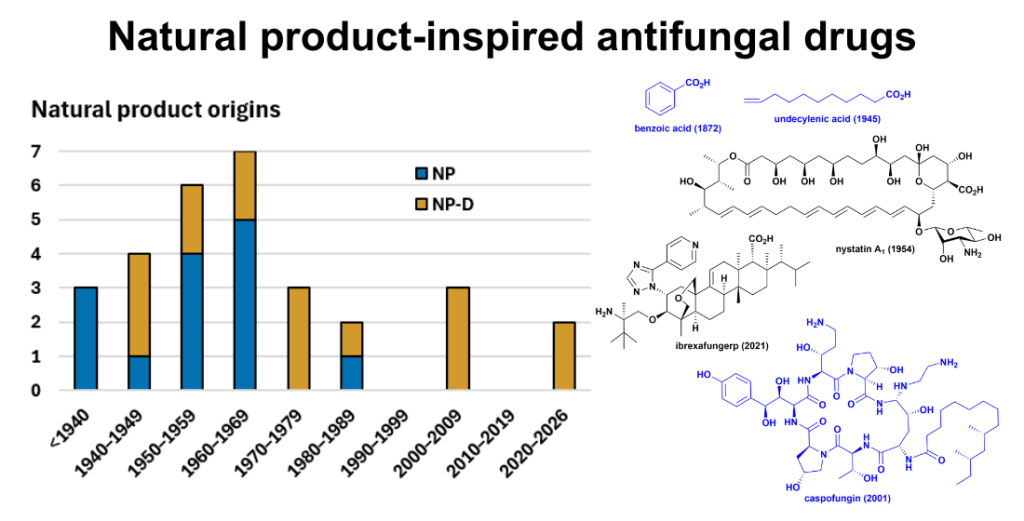
We have just published a new review of antifungal medicines detailing natural product (NP) and NP-derived agents introduced for human use between 1872 and August 2026. Across more than 150 years, 30 NP-inspired antifungal therapeutic entities have entered human use. Fourteen are NPs themselves, while 16 are semisynthetic derivatives or synthetic analogues with a direct structural relationship to a NP precursor.
A difficult pathogen problem
Antifungal drug discovery is challenging as fungi are eukaryotes and, therefore, share many cellular features with humans. That evolutionary proximity limits the number of fungal-selective targets and increases the risk that a compound active against a fungal cell may also damage human cells.
At the same time, the clinical need is rising. Multidrug-resistant Candida auris, azole-resistant Aspergillus fumigatus and terbinafine-resistant Trichophyton indotineae have emerged as important threats. Some moulds, including members of the Mucorales and Lomentospora prolificans, remain difficult or impossible to treat reliably with existing systemic agents. The problem is not only resistance. Antifungal treatment is constrained by toxicity, drug–drug interactions, limited oral options for invasive disease, variable access to diagnostics and major gaps in activity against particular pathogens.
Natural products helped build the antifungal armamentarium
The earliest agents in the review reflect a very different era of medicine. Benzoic acid was used as an antiseptic from about 1872, and topical combinations of benzoic acid with salicylic acid (e.g. such as Whitfield’s ointment) were used in the early twentieth century for dermatophyte infections. The modern antifungal era accelerated in the 1950s with the arrival of the polyenes. These NP macrolides, produced by soil-dwelling actinomycetes, transformed the treatment of serious fungal infections.
Polyenes nystatin and amphotericin B: landmark discoveries in the 1950s
The polyene complex nystatin was introduced in the United States in 1954 and became one of the first major antifungal medicines. It remains widely used for mucosal, gastrointestinal and superficial Candida infections. Its discovery also carries an exceptional scientific legacy. Nystatin was isolated from Streptomyces noursei by Elizabeth Lee Hazen and Rachel Fuller Brown at the New York State Department of Health. Their royalty income helped establish the Brown–Hazen Research Fund, which supported medical-mycology research and later scholarships for women scientists.
Another polyene, amphotericin B, followed in 1958 and remains one of the most important antifungal drugs ever introduced. It has broad activity against organisms including Candida, Cryptococcus, Aspergillus and many Mucorales. However, its use can come at a cost. Amphotericin B binds fungal ergosterol, but its interaction with human cholesterol contributes to infusion reactions and dose-limiting nephrotoxicity. Lipid-based formulations, particularly liposomal amphotericin B, substantially improved tolerability while preserving the drug’s clinical utility. Despite newer therapies, amphotericin B remains a cornerstone treatment for severe invasive mycoses and is also used against visceral leishmaniasis.
Nature provided scaffolds; medicinal chemistry made medicines
The review’s most important broader lesson is that NPs do not need to be used unchanged to be transformative. Natural scaffolds can provide the starting point for medicinal chemistry that improves safety, solubility, stability, pharmacokinetics or route of administration.
The echinocandins are perhaps the clearest example. These drugs emerged from fungal lipopeptide NPs that inhibited β-1,3-D-glucan synthase, an enzyme required to build the fungal cell wall. The original NP leads were relatively metabolically unstable, poorly soluble or toxic for routine clinical use. Semi-synthetic optimisation ultimately produced four clinical drugs: caspofungin (first approved in 2001), micafungin (2002), anidulafungin (2006) and rezafungin (2023). These agents are now central therapies for invasive candidiasis, with activity against Candida and, in relevant settings, Aspergillus. Their selective fungal cell wall target is particularly valuable because humans do not have a cell wall. Rezafungin illustrates how medicinal chemistry can change not only potency but also clinical practicality. It is an anidulafungin derivative engineered for greater chemical stability and an approximately 130-hour human half-life, enabling once-weekly intravenous dosing.
The value of a different scaffold
Ibrexafungerp provides another example of a NP-inspired advance. It is a semi-synthetic derivative of enfumafungin, a fungal-derived fernane triterpene glycoside. Like the echinocandins, it inhibits β-1,3-D-glucan synthase, but it interacts with a non-identical, partially overlapping binding region. That distinction matters because ibrexafungerp retains activity against many, though not all, echinocandin-resistant isolates. It also offers oral administration, a major practical advantage over the intravenously administered echinocandins. However, the story is also a reminder that approval does not automatically guarantee continuous patient access. Ibrexafungerp retained US regulatory approval but its commercial supply was interrupted after a voluntary recall associated with a potential manufacturing cross-contamination issue; no confirmed relaunch date had been identified at the review’s August 2026 cut-off.
A success story with a warning
The 30-drug dataset is encouraging: NPs and their derivatives have repeatedly delivered clinically important antifungals. Polyenes, griseofulvin, echinocandins and flucytosine have saved lives or transformed the management of fungal disease. Even older topical agents reveal how fungal therapy evolved from broad antiseptics towards targeted medicines. However, the dataset also reveals a limitation. Recent approvals are heavily concentrated around one biological process: fungal cell wall synthesis through β-1,3-D-glucan synthase inhibition. That target has clearly been productive, but a robust antifungal future cannot depend on repeated variations of a small number of mechanisms.
Resistance already occurs. In echinocandins, clinically important resistance is most often associated with mutations in the FKS1 or, particularly in Nakaseomyces (previously Candida) glabrata, FKS2 genes encoding glucan-synthase subunits. Polyene resistance remains less common overall, but altered ergosterol biosynthesis, cell wall remodelling and stress-response pathways can reduce susceptibility. Flucytosine, meanwhile, is especially vulnerable to resistance when used alone because fungi can lose or alter the uptake and metabolic pathways required to activate the drug.
The message is not that current antifungals have failed. Rather, it is that success must not breed complacency.
What comes next?
NPs alone will not solve every antifungal problem. But history shows that they have repeatedly provided the foundations on which antifungal medicine advances. From nystatin and amphotericin B to the echinocandins and ibrexafungerp, the natural world has supplied both medicines and molecular blueprints. The task now is to use those lessons to find the next generation of antifungal therapies before resistance, toxicity and persistent therapeutic gaps make the current options insufficient.
#AntifungalResearch #AntifungalResistance #NaturalProducts #DrugDiscovery #FungalDisease #MedicinalChemistry #InfectiousDiseases #GlobalHealth

