Story 1: Marine sponges. The first time I encountered taurine was during my PhD where we routinely isolated the zwitterionic taurine and trigonelline from marine sponges. A paper from around that time found that taurine was often the most abundant amino acid in marine sponges, along with hypotaurine and glycine. Interestingly recent work has reported that taurine plays a role in host-symbiont interactions in Ianthella basta – a sponge that I worked on during my PhD and Postdoc (here and here).
Story 2: Antibacterial. In November 2023, the FDA approved the use of a taurolidine and heparin (DefenCath®) as a “catheter lock solution to reduce catheter-related bloodstream infections in adult patients with kidney failure who are receiving chronic hemodialysis through a central venous catheter.” A taurolidine containing catheter lock solution TauroSept® has been available in Europe since 2006. The use of catheter lock solutions was reviewed in 2022 for those interested. Taurolidine has weak broad spectrum antibacterial activity against both G+ve and G-ve bacteria. In aqueous solution, taurolidine is equilibrium with several species, which have antibacterial activity: the methylol groups can react with peptidoglycan, endotoxins and exotoxins, while taurine and taurinamide also have weak antibacterial activity.
Story 3: Energy drinks. In addition to caffeine, energy drinks such as Red Bull contain taurine, several B vitamins and sugars/sugar substitutes. In Australia, there is 400 mg/100mL of taurine and 32 mg/100 mL of caffeine, but these levels can vary by country. Red Bull GmbH is one of the most interesting companies in the world, which was recently explored in Founders podcast #333 (highly recommended).
The discovery, antibacterial profile, and mode of action (MoA) of zosurabalpin, which belongs to a new antibacterial class called ‘tethered macrocyclic peptides’ (MCPs), was recently disclosed in two Nature papers (here and here, as well as a commentary). Zosurabalpin is currently being evaluated in a phase 1 trial by Roche for the treatment of carbapenem-resistant Acinetobacter baumannii (CRAB) infections. A. baumannii is classed a Priority Pathogen by the WHO and these infections, while being relatively rare at this moment in time, have high mortality and morbidity. These two papers are very detailed andthis blog highlights only some of the work undertaken!
Hit Discovery: Whole-cell phenotypic screening of a 44,985 member MCP library identified a cluster of active MCPs. One of these hits, RO7036668, displayed selective activity against A. baumannii, but no cytotoxicity (promising).
Hit to lead to clinical candidate: Iterations of medicinal chemistry and testing led to the identification of MCPs such as RO7075573 with more potent in vitro and in vivo mouse model activity against A. baumannii; however, it was observed during pre-clinical toxicology studies that RO7075573 caused aggregation of low-density lipoprotein/high-density lipoprotein vesicles in rat plasma through an unknown mechanism. Using an in-house developed rat plasma precipitation assay, the team showed that zwitterionic (definition) tethered MCPs had significantly reduced plasma precipitation and zosurabalpin was ultimately selected for development. It had been previously shown that zwitterionic compounds can have enhanced Gram-negative bacterial membrane transport — see O’Shea & Moser and Muñoz & Hergenrother for discussions on bacterial entry.
Mode of action (MoA): Sequencing of resistant mutants suggested that the zosurabalpin’s target was likely to be the protein complex LptB2FGC, which is an ATP-binding cassette used by Gram-negative bacteria to move lipopolysaccharide (LPS) from their inner membrane to the outer layer of the outer membrane. It was shown that MCPs helped to trap LPS in the protein complex by several orthogonal methods including Cryo-EM.
Did you know that A. baumannii can survive without LPS in its outer membrane? Amazingly it can! It was shown that MCPs failed to inhibit the growth of LPS-deficient A. baumannii, which supported the proposed MoA. The LPS-deficient phenotype can be produced in response to polymyxin treatment, but there is a significant fitness cost, as well as increased susceptibility to other antibiotics and disinfectants.
Looking forward: Zosurabalpin has only just started its clinical development (safety and dosing). Although the total number of A. baumannii infections is (mercifully) relatively low, perhaps a multi-site, multi-country clinical strategy could be used in phase 3, similar to the trial successfully completed for the β-lactam and β-lactamase inhibitor combination sulbactam-durlobactam. Although it could be theoretically possible to undertake an Acinetobacter specific trial using rapid diagnostics, the frequency of polymicrobial infections in clinical settings could lead to the need for the development of combination therapies with other antibiotics with activity against other pathogens such as Pseudomonas, Klebsiella and E. coli, may be even MRSA. It will be interesting to what directions are taken.
Concluding remarks: The discovery and development of zosurabalpin and the unravelling of its clinically unexploited MoA is very impressive. Importantly, the team also included how they overcame development hurdles, which is very valuable information for antibacterial drug discoverers. Recent successful clinical trials have shown that it is possible to run multi-site, multi-country trials for these deadly Gram-negative infections and the approval of a novel class of antibiotics to treat CRAB infections will be welcomed by clinicians. Now the world needs to make sure that adequate funding is available for these types of phase 3 trials, as well as ensure that incentives such as the Pasteur Act or similar pull incentives are introduced as soon as possible. Otherwise, novel antibiotics with life saving potential may not make it to patients. Remember, paraphrasing Mike Tyson “Everyone has a plan until they get punched in the mouth a drug-resistant Gram-negative infection.”
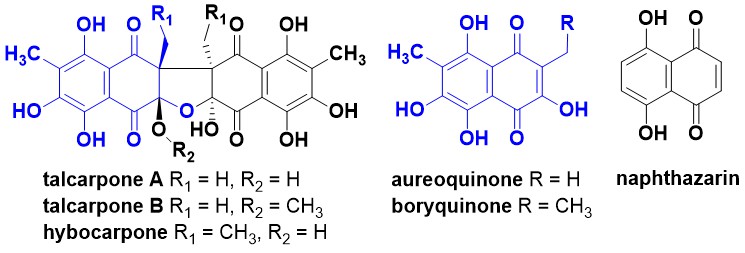
These compounds were isolated from Talaromycesjohnpittii sp. nov., which was named after John Ingram Pitt (1937–2022), an Australian food microbiologist and mycologist.
The structures and relative stereochemistry of talcarpones A and B were secured by analysis of MS and NMR data. The absolute configuration of the talcarpones was tentatively assigned as 1 S,10 S,1′S,10′S using ECD calculations.
The talcarpones and aureoquinone are homologues of hybocarpone and boryquinone, respectively. This is the first report of a homologue of hybocarpone, which had been previously reported from several fungal lichen symbionts. Although the relative configuration of hybocarpone was previously confirmed by X-ray crystallography and total syntheses, the absolute configuration was not assigned.
Talcarpone A had MICs of 1.6 µg/mL against Candida albicans and Saccharomyces cerevisiae, and 12.5 µg/mL against Bacillus subtilis and Staphylococcus aureus.
Talcarpone B was shown to convert to talcarpone A in aqueous acetonitrile, which then partially converted to aureoquinone by an unknown mechanism.
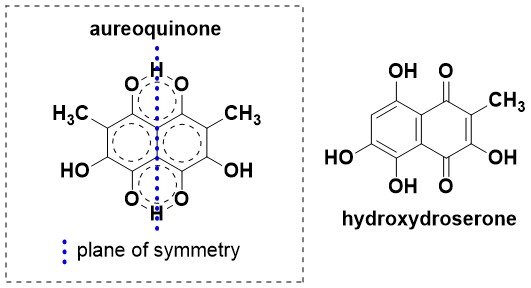
The NMR data of aureoquinone showed that it contained a plane of symmetry. We hypothesised that facile intramolecular proton transfer mediated by proton tunnelling leads to very rapid tautomerisation and averaging of the quinone/quinol carbon resonances in aureoquinone, as has been reported for other symmetrical naphthazarins. Interesting, proton tunnelling is eliminated in asymmetrical environments such as hydroxydroserone.
The culmination of my time consulting for the WHO was the publication of “Analysis of the Clinical Pipeline of Treatments for Drug-Resistant Bacterial Infections: Despite Progress, More Action Is Needed”, which was just announced as one of the Antimicrobial Agents and Chemotherapy (AAC) 2023 Top Cited Collections. Open access here.
I am pleased to announce that I have been selected as a Clarivate Highly Cited Researcher for Pharmacology & Toxicology in 2023. I was also a highly cited researcher in 2016, 2017 and 2022 in Pharmacology & Toxicology and in 2021 in Cross-Field.
The criteria for 2023 was slightly changed from previous years: “Each researcher selected has authored multiple Highly Cited Papers™ which rank in the top 1% by citations for their field(s) and publication year in the Web of Science over the past decade. However, citation activity is not the sole selection indicator. A preliminary list based on citation activity is then refined using qualitative analysis and expert judgement.”
A special thanks to my recent co-authors and supporters!
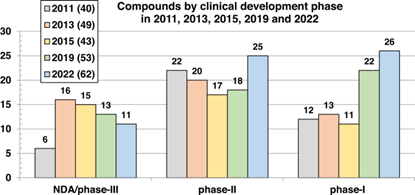
There are 47 direct-acting antibacterials, 5 non-traditional small molecule antibacterials, and 10 β-lactam/β-lactamase inhibitor (BLI) combinations under clinical development as of December 2022 (Total = 62)
At the start of the pipeline, there are now more than double the number of phase-I candidates (26) compared to 2015 (11), while funding initiatives have also helped to boost the number of phase-II (25) compounds since 2019 (18) (see Figure below).
Encouragingly, 16/26 (62%) of the compounds in phase-I and 14/25 (56%) in phase-II contain new pharmacophores.
Two new small molecule antibacterial drugs first approved between 2020 and 2022: levonadifloxacin and its prodrug in India in 2020 and the oxazolidinone contezolid acefosamil in China in 2021. Recently, the sulbactam-durlobactam BLI combination was approved in the USA.
One ‘non-traditional’ antibacterial, Rebyota, was approved in the USA in 2022 and recently, another, Vowst, was approved in the USA – both for C. difficile.
Despite the encouraging trends in the early stage of the pipeline, further support will be needed to increase the number of new antibacterial drugs launched onto the market.
Figure. Comparison of the numbers of compounds undergoing clinical development as of 2011, 2013, 2015, 2019 and 2022 by development phase