
🧪 Exploring how natural product chemistry can trigger unexpected occupational skin reactions
As someone passionate about natural products and workplace safety, I’ve always been mindful of autoxidation—and I recently discovered it’s responsible for turpentine dermatitis. This skin reaction results from exposure to turpentine, a solvent derived from pine resin commonly used in paints, varnishes, and cleaning products.
❓ What is Turpentine Dermatitis?
This condition typically presents as irritant contact dermatitis (redness, itching, scaling) or, in some cases, allergic contact dermatitis (blistering, swelling), following direct contact with turpentine or its vapours. While it’s less common today due to safer alternatives, it remains a risk for painters, artists, and industrial workers. Prevention involves protective gear, proper ventilation, and immediate washing of skin after exposure.
🔬 What is Autoxidation and The Role of Monoterpene Hydroperoxides?
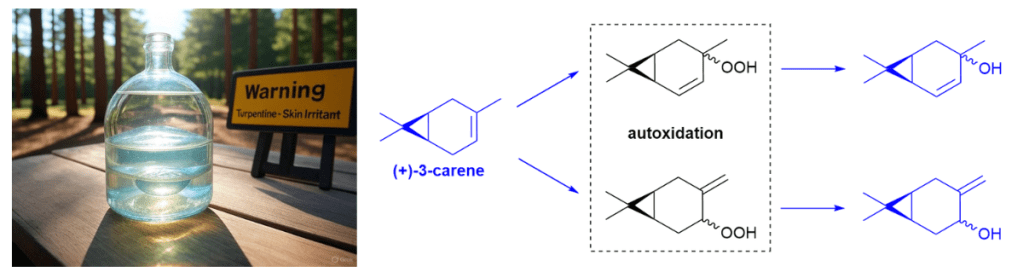
A key culprit in allergic reactions is monoterpene hydroperoxides (ref. 1), formed when components of turpentine (such as Δ-3-carene, Figure 1) oxidise upon exposure to air or light—a process known as autoxidation (ref. 2). In natural products research, we often isolate the corresponding reduced alcohols. These hydroperoxides are potent skin sensitisers, triggering immune responses that cause severe itching and inflammation. They may also act as irritants, worsening skin damage. To minimise oxidation, turpentine should always be stored in airtight, dark containers.
💡 Why It Matters…
● Although turpentine use has declined, monoterpene hydroperoxides remain relevant in essential oils and pine-derived products, posing ongoing risks for sensitisation.
● Whenever natural products with allylic alcohols or peroxides are isolated, consider the possibility that they are autoxidation products. Also be mindful of autoxidation during storage—store potential candidates under argon and in the dark where possible.
References
1. One hundred years of allergic contact dermatitis due to oxidized terpenes📘Contact Dermatitis, 2021, 85: 627–636 🔗 https://doi.org/10.1111/cod.13962
2. Autoxidation vs. antioxidants – the fight for forever 📘Chemical Society Reviews, 2021, 50: 7343–7358 🔗 https://doi.org/10.1039/D1CS00265A
 MSBChem Consulting