
Evidence of tetracycline containing fermentations in northern Africa around 1,500 years ago.
This is some older research published in 2010 (available here) that I recently read, which I wanted to share.
Some bones excavated from northern Africa (modern day Egypt and Sudan) burials have bright yellow-green fluorescent bands (λ 490 nm), which was similar to those observed in people treated with first generation tetracycline antibiotics. When first found, fluorescent bands were conjectured to have formed post death or through infection. More on the history of tetracycline (ancient uses and its rediscovery) can be found in this lecture text (available here).
Bones from a four-year-old Nubian child buried around 1,500 years ago were demineralised with hydrofluoric acid (HF) to release the fluorescent compound(s) (available here). HPLC-MS analysis showed two closely eluting peaks with a m/z of 427.1 Da. Authentic standards were derived from HF treatment of tetracycline, oxytetracycline and chlortetracycline, which resulted in aromatisation of the B ring and racemisation of the A ring N-dimethyl group at C6 (see Figure 1). These diastereomers could be separated by HPLC-MS and it was shown that the bone-derived fluorescent compounds had the same retention times and MS as the acid treated products from tetracycline. This study provided unequivocal evidence that the Nubians had access to a tetracycline producing Actinomycetes, which they presumably used for medical purposes (treatment and/or prophylactic). Tetracycline antibiotics were not used in modern medicine until their re-discovery in the 1950s. Since then, several semi-synthetic and synthetic tetracycline drugs have been approved and are used to treat a variety of infections.
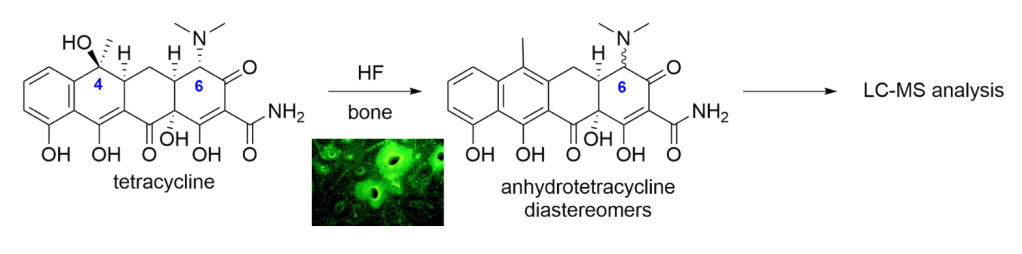
Figure 1. Bone was treated with HF, which liberated anhydrotetracycline diastereomers that were analysed by LC-MS and an authentic standard. The bone picture used was sourced from “Ancient brew masters tapped drug secrets”, Emory University 2010 (available here).
Some thoughts: It is fascinating that tetracycline fermentation broths were used at least 1,500 years ago. We don’t know what happened, but I hope that some of these people weren’t some of the first to be infected with drug-resistant bacteria. Although some traditional fermentation knowledge has survived (e.g. alcohol production and Chinese red yeast rice), I wonder if other crude antibiotics were used by the Nubians or other peoples, but no traces were left (or have been discovered yet). It was hypothesised that tetracycline-containing broths were drunk. However, the tetracycline production levels must have been quite high to leave multiple fluorescent bone staining bands. Perhaps concentration steps could have used such as cloth filtration and/or evaporation. Actinomycetes can also grow on solid media and there is a possibility that a grain could have been used in an analogous way to red yeast rice.
 MSBChem Consulting